



Quick Stats
| Detail | Info |
|---|---|
| Provider | NetEnt |
| Game Type | Video Slot |
| RTP | 96.33% |
| Volatility | Medium-High |
| Reels / Rows | 5 × 4 |
| Paylines | 1,024 Ways to Win |
| Min Bet | $0.20 |
| Max Bet | $400 |
| Max Win | ~2,000x stake |
| Features | Reversed Avalanche, Level Multiplier, Free Spins, Scatter |
| Theme | Art Deco / Gems |
| Release Date | 24 June 2019 |
| Platform | Desktop & Mobile |
What Is Cash-O-Matic?
Cash-O-Matic is a 5-reel, 4-row slot from NetEnt that discards the conventional cascading reel formula and reverses it. In most Avalanche slots, winning symbols disappear and new ones drop in. Here it works the opposite way: winning symbols stay put on the grid, while all non-winning symbols vanish and fresh ones fall to fill the gaps. This creates a layering effect that can chain into multiple wins off a single stake.
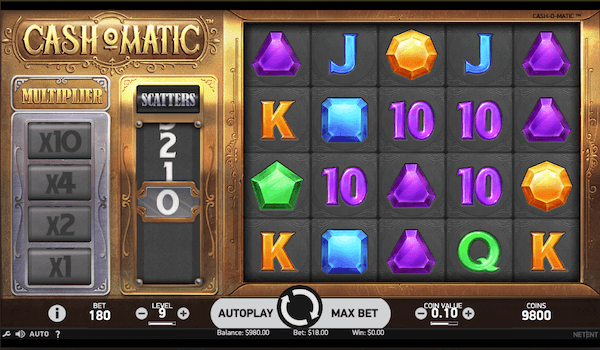
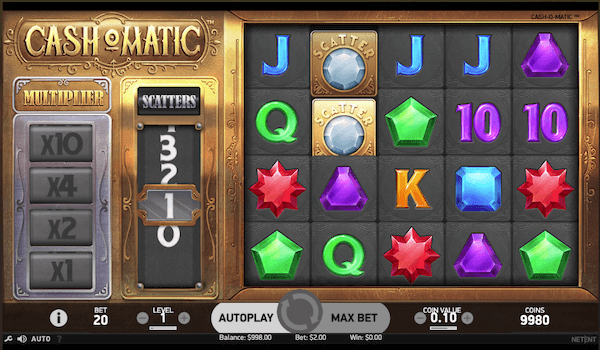
The game divides its screen into three visible sections: a multiplier meter on the far left, a scatter counter in the middle, and the 5×4 reel grid on the right. This layout can look strange at first, but it makes sense once you understand how the multiplier and scatter mechanics feed into each other.
This slot suits players who are comfortable with medium-high variance — meaning sessions can run dry for a stretch before paying out in a concentrated burst. It is not built for casual spins with guaranteed action every round. If you prefer regular small wins and low-risk play, this one is not for you. If you are patient and happy chasing the free spins trigger, it rewards that approach.
RTP and Volatility
Cash-O-Matic carries an RTP of 96.33%, putting it just above the industry standard of around 96%. In plain terms: over tens of millions of spins, the game returns roughly $96.33 for every $100 wagered. That is a theoretical long-run figure across the full player pool — it does not predict what happens in your individual session. A single $20 session on a medium-high volatility pokie can go either direction.
The medium-high volatility label — confirmed across multiple independent reviews and aligned with NetEnt’s own characterisation — means wins arrive less often but tend to be larger when they land. The hit frequency sits at approximately 12%, which is low. Most spins will not produce a winning combination. That makes bankroll discipline important here. Budget your session before you start, not mid-spin.
Betting Range
The minimum bet is $0.20 per spin and the maximum is $400, giving this pokie one of the wider ranges you will find from NetEnt. Casual players can comfortably sit at the lower end. The high maximum makes this game viable for high rollers, especially because the multiplier mechanic scales directly with your bet — a 50x multiplier on a $400 spin is a very different outcome from the same multiplier on a $0.20 bet.
There are 10 bet levels, and you can also adjust the coin value from $0.01 to $0.50. An autoplay function and a max bet shortcut are available in the lower controls.
Do this: Before your first real-money session, open the paytable to check current symbol values and decide on a per-session budget. Given the low hit frequency, sizing your bets to last at least 50–100 spins gives you a realistic window to see the free spins trigger.
How to Play Cash-O-Matic — Step by Step
- Set your bet. Use the coin value selector (0.01–0.50) and bet level (1–10) in the bottom panel. The resulting total stake per spin is displayed clearly. Start low while you learn the multiplier system.
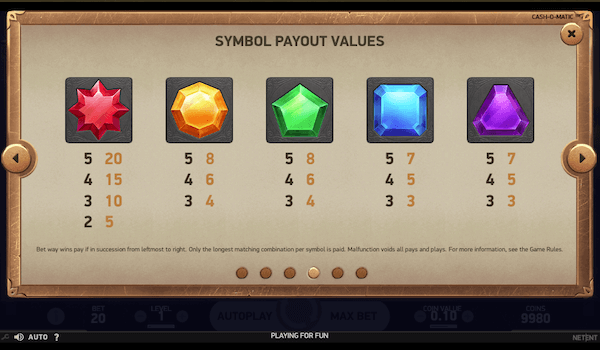
- Check the paytable. Tap the paytable icon before spinning. Symbol values are low by design — the game’s real payout potential sits in the multiplier tiers and free spins, not individual symbol combinations.
- Spin and watch the Avalanche. Hit the spin button. Symbols drop from above. Any winning combination locks the winning symbols on the grid while all others disappear. New symbols drop into the empty spaces.
- Watch the Level Multiplier meter. If a full row becomes filled with winning symbols, the multiplier activates. Fill one row for 1x, two rows for 2x, three rows for 4x, four rows for 10x. This multiplier stacks with each avalanche in the same spin sequence.
- Track the scatter counter. Each scatter symbol that lands is collected in the scatter meter rather than staying on the grid. Scatters do not pay individually — they count toward the free spins trigger.
- Free spins trigger at 10+ scatters. Once 10 or more scatters are collected within one spin sequence, the free spins round begins. Each scatter counts as one free spin, so 10 scatters = 10 free spins, 20 scatters = 20 free spins, and so on.
Try this: Play 20 spins at the minimum $0.20 bet to understand how the Avalanche chains work before raising your stake. Each spin takes under 10 seconds, so this costs you under $4 and gives you a full working sense of the mechanics.
Symbols and Paytable
Cash-O-Matic uses two tiers of symbols — low-value playing cards and high-value gemstones — plus a scatter. There are no wild symbols in this game, which is unusual and worth knowing before you spin.
The low-value group consists of standard royal card symbols: 10, J, Q, K, and A. These pay the smallest amounts and are responsible for most of the non-winning frustration the game is known for.
The five gemstone symbols are the high-value group, ranked by colour: purple, blue, green, yellow, and red. The red star-shaped gem is the most lucrative, paying 20x your total stake for a five-of-a-kind combination on 1,024 ways. That sounds generous until you factor in that the game’s value is driven almost entirely by the multiplier layers, not raw paytable payouts. Individual wins without multipliers are modest by design.
The scatter symbol appears encased in bronze and stands out visually from the gemstones and cards. It does not award an immediate cash payout — its sole function is to accumulate in the counter and build toward the free spins trigger.
Bonus Features
The Reversed Avalanche
This is Cash-O-Matic’s signature mechanic and the engine that powers every other feature. When a winning combination lands, the winning symbols are pinned to the lower portion of the grid. All non-winning symbols disappear, and a new set of symbols drops from above into the vacant spaces. If the new symbols create another winning combination, the sequence continues — building layers of locked winning symbols and clearing non-winners again. The chain only stops when no new winning combination forms.
This reversed approach differs from the Gonzo’s Quest-style cascade. In standard cascades, the winning symbols leave. Here, they stay and accumulate, which means your grid gradually fills with winning symbols. That is the mechanic that feeds the Level Multiplier.
Level Multiplier
The multiplier activates when at least one complete row of the 4-row grid is filled entirely with winning symbols. Four multiplier tiers exist:
- One full row: 1x applied to your win
- Two full rows: 2x applied to your win
- Three full rows: 4x applied to your win
- All four rows filled: 10x applied to your win
This multiplier applies to your total win for that Avalanche chain. In the base game, 10x is the ceiling. The multiplier resets to zero at the start of each new paid spin. Filling all four rows in a single spin sequence is rare, but when it happens, it changes the scale of your payout entirely.
Free Spins
Free spins trigger when you collect 10 or more scatter symbols within a single spin sequence (including all Avalanche chains within that spin). Each scatter collected equals one free spin. Collect exactly 10 scatters and you enter with 10 free spins. Collect 20 scatters and you enter with 20. During free spins, each complete row of winning symbols adds one additional free spin to your remaining count, so the feature can extend well beyond your starting number.
The critical difference in free spins is the multiplier structure, which scales with how many scatters triggered the feature:
- 10–14 scatters collected: multiplier levels are 2x, 4x, 8x, 20x
- 15–19 scatters collected: multiplier levels are 3x, 6x, 12x, 30x
- 20+ scatters collected: multiplier levels are 5x, 10x, 20x, 50x
Triggering the feature with 20 or more scatters — getting to that 50x fourth tier — is where the realistic 2,000x max win lives. It requires the Avalanche to fully fill all four rows during a free spin with the highest multiplier tier active. It happens, but it is rare.
Is Cash-O-Matic Worth Playing?
Pros:
- RTP of 96.33% sits above the industry average — solid for a high-variance NetEnt pokie
- The reversed Avalanche mechanic is genuinely different from standard cascades and creates a building tension that works
- Free spins multiplier scaling (up to 50x) gives the feature real weight when it triggers
- Wide bet range ($0.20–$400) suits both casual NZ players and high rollers
Cons:
- No wild symbol — unusual for a modern slot and it limits how often wins form in the first place
- Low hit frequency of around 12% means most spins are blank, which becomes tedious over longer sessions
- The free spins trigger requires 10+ scatters within one spin sequence — it can take a long time to arrive
- Paytable values for individual symbols are very low; the game is almost entirely dependent on the multiplier system to produce meaningful returns
- The art deco design, while coherent, is visually flat compared to other NetEnt releases
Cash-O-Matic is a focused, mechanics-first pokie built for patient players who understand what they are getting into. If you enjoy the tension of watching a multiplier meter build, this is genuinely interesting. If you want frequent small wins and visual flair, look elsewhere. It suits experienced NZ pokie players with a set bankroll — not beginners or casual spinners looking for entertainment between bonuses.
Responsible Gambling
Cash-O-Matic uses a certified random number generator (RNG). Every outcome is independent and completely random — no spin history, no strategy, and no betting system can influence the result. Set a session budget before you play and stop when you reach it. If gambling is affecting your enjoyment, finances, or relationships, contact your local responsible gambling support service for help.